

How I Built a $30K/month Business Working 3 Hours a Day (Before I Had Any Team)
This is the most detailed newsletter I have ever sent out. I'm literally telling on myself


Today marks exactly 28 months since I crossed my first $30,000 in monthly revenue as a complete solopreneur, working just 3 hours a day. No team, no fancy tools, no venture capital - just me, my laptop, and these 9 counterintuitive strategies that changed everything.
Well this only lasted 5 months because I couldn’t keep up with the rate I was going with it and my business model wasn’t helping either. However, it was an awesome 5 months and a good run. Had to modify my business model and eventually secured a team.
Here's the behind-the-scenes breakdown of what actually worked at the time:
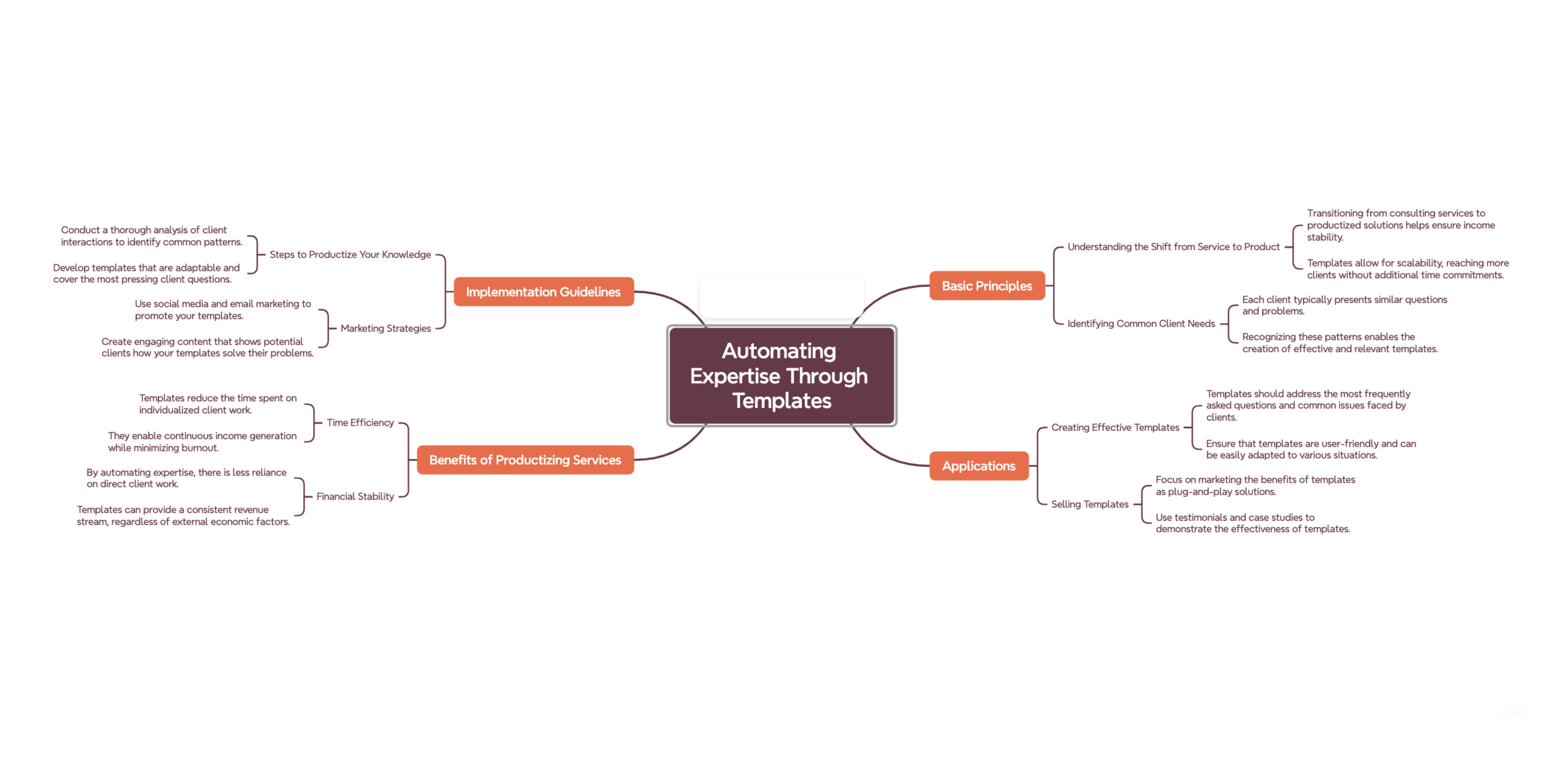
#1: I Automated My Expertise Into Templates
Instead of selling my time, I packaged my knowledge into templates that could sell while I slept. To be honest, business consulting as a pure service model is fragile: high dependency on your time, client turnover, economic shifts, and burnout risk.
The breakthrough came when I realized every client was asking me variations of the same 5 questions and coming to me with the same issues 98% of the time.
So, I productized my services.
What I Sold (No Courses, Just Plug-and-Play Solutions):
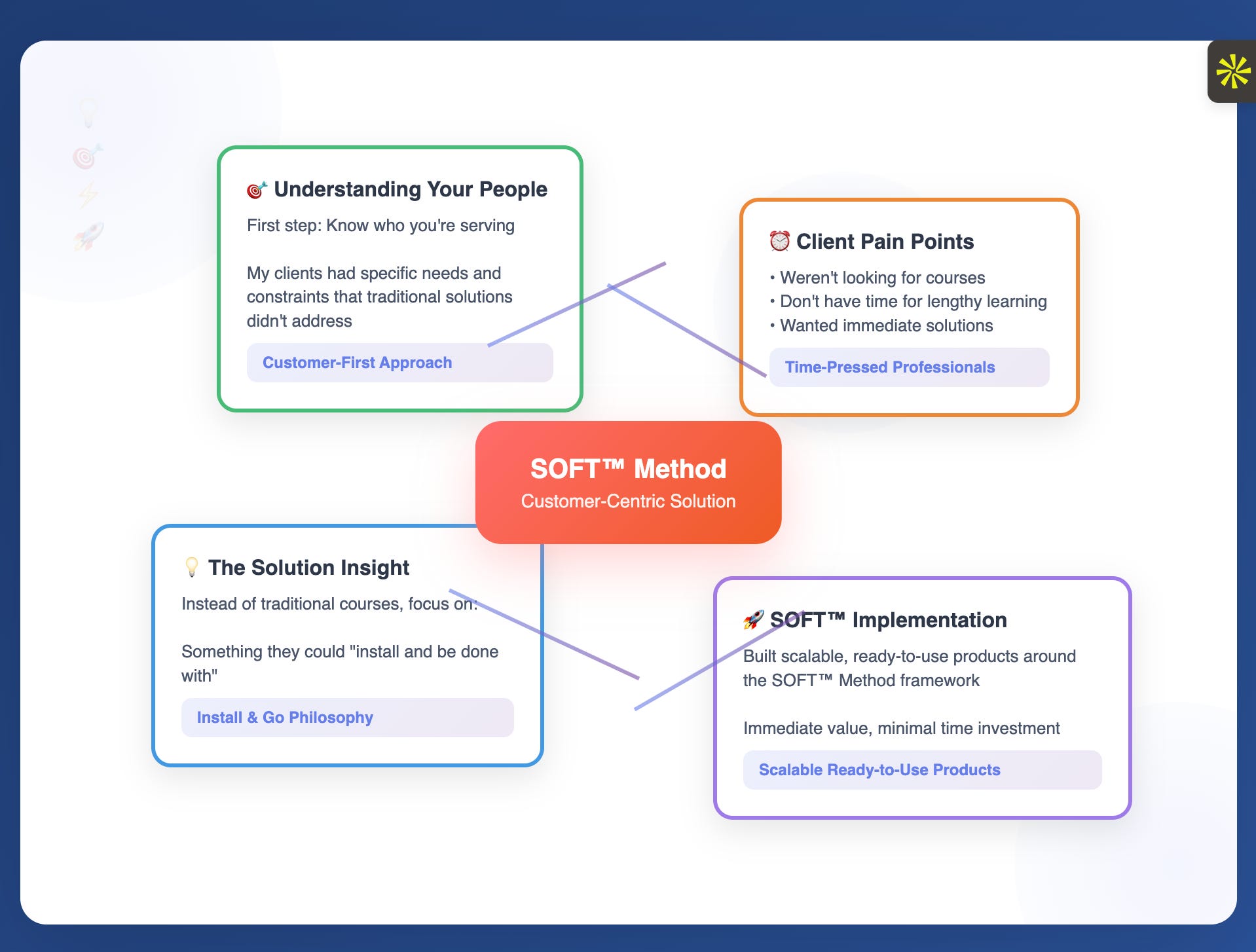
First off, it’s important to understand the people you are serving. My clients weren’t looking for courses. They really don’t have the time. They just wanted something they could install and be done with. So, instead of building a traditional course, I focused on scalable, ready-to-use products built around my SOFT™ Method.
Products:
CORE Product: SOFT™ Method Toolkit (base price $599, highest price $2,500)
Includes Notion/Airtable/ClickUp templates, SOP bundles, workflow audit templates, asynchronous onboarding systems, Loom walkthroughs, and automation guides.
Flagship Online Program (cohort-based $1,500/ month)
Structured program for founders and ops managers, video lessons on each SOFT™ pillar (Simplify, Optimize, Flowify, Transfer), templates, SOPs, bonus “Hiring for Ops” masterclass.
The secret not to create generic templates. I built them based on real problems I'd already solved 20+ times. This meant zero guesswork about market demand.
Revenue generated: $18,000 in the first month
#2: Unconventional Networking
If you’d asked me two years ago what “networking” meant, I would’ve rattled off the usual suspects: LinkedIn requests, coffee chats, and the endless cycle of “just checking in” emails.
The actual truth is that I was terrible at following up. Not because I was lazy, but because deep down after connecting with a person, I had no idea what to do next, so I’d just quietly disappear.
Everything shifted when I stopped trying to close and started connecting others. Instead of only pursuing leads, I introduced people in my network who could help each other. I’d send, “Hey, you two should meet” emails or tag people on LinkedIn if I saw a fit. No agenda.
People remembered me, not as someone who wanted something, but as someone who made things happen.
Even as a frequent traveler, I kept a Notion list of contacts and made a habit of making a few introductions every week. When I visited a city, I’d reach out to my network, ask who I should meet, and sometimes host small dinners for people I’d connected with. If you know me, you know how much I love to cook and host. I put a lot of energy into these intimate gatherings, even though I rarely post about them online. I’m extra like that.

When people needed what I offered, I was the first person they thought of. My best clients and collaborations have come from these no-strings-attached introductions.
The lesson?
When you network to give, not get, you become unforgettable.
Not sure how to network strategically?
My friend
provides bite-sized business networking and referral building tips for B2B business owners. He often shares overlooked strategies, including how to get referrals without needing an intro. Subscribe to his newsletter hereHere are my top 3 posts of his
Use referrals to test & validate your marketing & sales content
Want better results from your networking? Start with this...
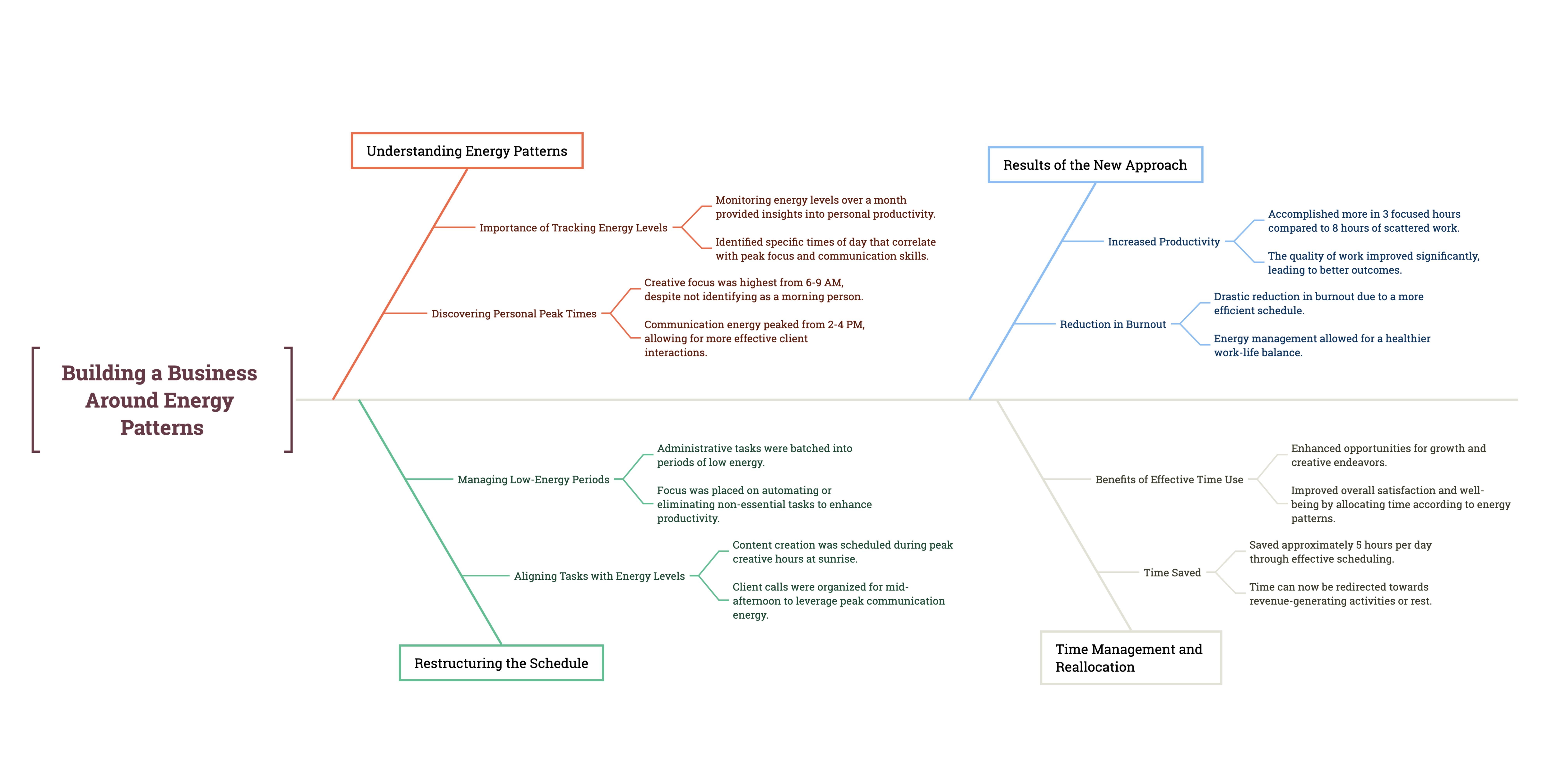
#3: I Built My Business Around My Energy Patterns, Not Industry Standards
Most entrepreneurs try to optimize their schedule around what they think they "should" be doing. I did the opposite.
I tracked my energy levels for 30 days and discovered I had peak creative focus from 6-9 AM and peak communication energy from 2-4 PM. Everything else was mediocre at best. (It’s funny because I am not even a morning person)
So I restructured everything: Content creation happened at sunrise. Client calls were scheduled for mid-afternoon. Administrative tasks got batched into my lowest-energy periods (automated or eliminated entirely).
The result: I accomplished more in 3 focused hours than I used to in 8 scattered ones. Quality shot up, burnout reduced drastically.
Time saved: 5 hours per day, which I converted into either revenue-generating activities or actual rest, whatever a girly girl does in her day.
#4: I Created One Perfect Week and Copy-Pasted It
Instead of reinventing my schedule every week, I designed one optimal week and repeated it for months.
Here’s what actually worked for me: I made a list of the 3 things I absolutely had to do every week to move my business forward. Then I set alarms on my phone for those blocks. No fancy planner, just recurring reminders.
For example, I’d get a ping at 9:30am to engage on LinkedIn and follow up with leads, another at 1pm to prepare for any client meeting on my calendar because it’s usually just 2 open slots a day, and one at 4pm to check off admin. Other things after that were usually personal. I have a real life.
PS: I meal prep every Sunday. It sets the tone for the rest of my week. I love food and hate to worry about it.
If something didn’t fit those blocks, it waited. I stopped trying to multitask or fill every gap. Most weeks, I finished early. It wasn’t perfect, but it was the first time my days felt under control.
The beauty was in the predictability. Clients knew when they could reach me. I knew exactly what I'd be working on at any given time. Decision fatigue vanished because the framework was already set.
I only adjusted this template when something definitively wasn't working, not just because I felt like changing things up.
Productivity increase: Estimated 40% improvement in output quality
#5: I Charged More and Worked Less (Seriously)
This sounds backwards, but raising my prices was the single best thing I did for my work-life balance.
When I charged $50/hour, I needed 20 hours of client work per week to hit $1,000. When I raised my rate to $1,000/hour, I only needed 1 hour to hit $1,000. Those extra 19 hours went into building systems, creating content, and developing products that generated passive income.
Higher prices also attracted better clients. The people willing to pay premium rates typically had clearer expectations, respected my time, and caused fewer headaches overall.
The fear of pricing yourself out of the market is usually unfounded. There are always people willing to pay more for quality, and those are exactly the clients you want.
Revenue impact: 300% increase in hourly rate over 12 months
#6: I Made Everything Asynchronous by Default
Real-time communication became the exception, not the rule.
I moved 90% of my client communication to email, Loom videos, and shared documents. Instead of jumping on calls to discuss every little detail, I'd record a 5-minute video walkthrough or write detailed email responses that clients could reference later.
This eliminated the constant context switching that was killing my productivity. Instead of being "on" for 8 hours a day, I could batch my communication into specific windows and spend the rest of my time in deep work mode.
Clients actually preferred this approach once they got used to it. They had written records of our discussions, could review things at their own pace, and didn't have to coordinate schedules for every minor question.
Meetings eliminated: 80% reduction in scheduled calls
#7: I Outsourced My Weaknesses to Software, Not People
Instead of hiring team members (which I couldn’t at the time), I found tools that could handle the tasks I was terrible at.
I'm awful at bookkeeping, so I used automated accounting software instead of hiring a bookkeeper. I procrastinate on social media, so I used scheduling tools instead of hiring a social media manager. I forget to follow up with leads, so I set up email automation instead of hiring a sales assistant.
This approach was cheaper than hiring and gave me more control over the quality. Plus, I didn't have to manage anyone, which saved enormous amounts of time and mental energy.
The key was being brutally honest about what I was genuinely bad at versus what I simply didn't enjoy doing. “Bad at” meant outsource to software. “Didn't enjoy” meant either automate or eliminate entirely.
Monthly savings: $2,000+ compared to hiring equivalent human help
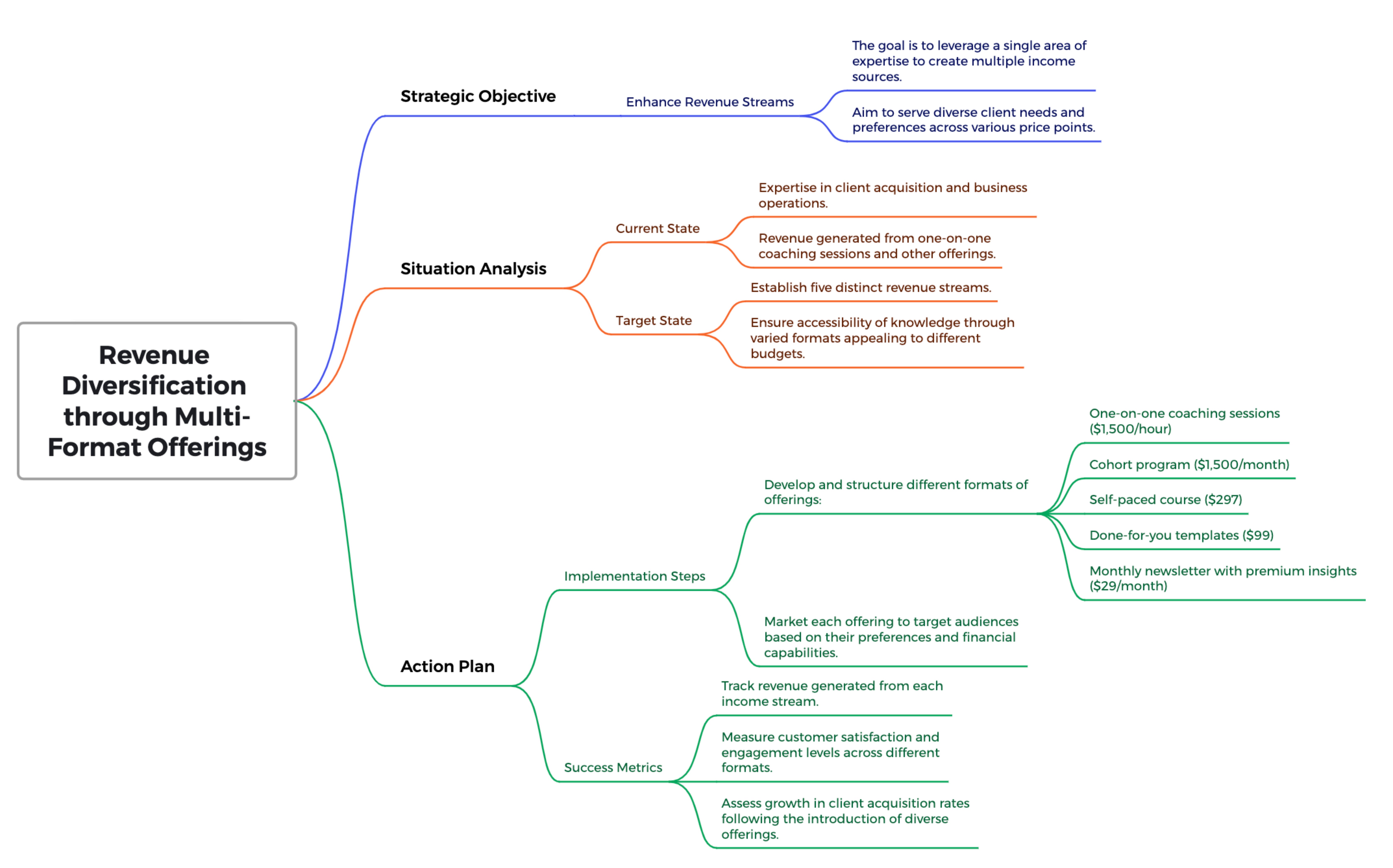
#8: I Sold the Same Thing in Multiple Formats
One core expertise became five different revenue streams.
My knowledge about client acquisition and designing human-friendly business operations became: one-on-one coaching sessions ($1,500/hour), a cohort program ($1,500/month), a self-paced course ($297), done-for-you templates ($99), and a monthly newsletter with premium insights ($29/month).
The beautiful part was essentially teaching the same concepts in different formats for different price points. Someone who couldn't afford individual coaching could still access my expertise through the course. Someone who preferred community learning could join the group program.
This strategy maximized the value I could extract from my knowledge while serving people with different budgets and learning preferences.
Revenue diversification: 5 income streams from one area of expertise
#9: I Turned Rejections Into My Best Marketing Content
Every "no" became a case study, every failed pitch became a lesson worth sharing.
When a potential client rejected my proposal because my prices were "too high," I wrote a detailed post about value-based pricing. When someone ghosted me after our discovery call, I created content about red flags in client relationships.
The counterintuitive part? I never badmouthed anyone or shared confidential details. Instead, I focused on the broader lessons these experiences taught me about business.
This approach accomplished two things: it positioned me as someone who learns from setbacks (relatability), and it attracted better clients who resonated with my perspective on professional standards.
Revenue generated: Didn’t track this directly, but this content consistently brought in my highest-paying clients
The Real Secret: I Stayed a Practitioner First, Entrepreneur Second
The biggest mistake I see solo entrepreneurs make is focusing more on building their business than staying excellent at their craft.
I never stopped doing the work that made me valuable in the first place. Even as I built systems and created products, I maintained direct client relationships to keep my skills sharp and my insights fresh.
This meant every piece of content I created was grounded in recent, real experience. Every product I developed solved problems I was actively encountering. Every strategy I shared was something I was currently testing in my own business.
The moment you stop practicing your craft to focus purely on business building, your expertise starts getting stale. And stale expertise doesn't command premium prices or generate compelling content.
The foundation: Everything else only worked because this stayed true
The hardest part wasn't implementing any single strategy - it was resisting the urge to constantly add more complexity. When something was working, I forced myself to keep doing it instead of chasing the next shiny tactic.
Building a low-effort business doesn’t mean finding shortcuts to avoid work entirely. It's more like being incredibly intentional with where you spend your limited time and energy, then building systems that amplify those efforts far beyond what you could accomplish through pure hustle.
The goal isn't to work less because you're lazy. It's to work less because you're strategic.
If this resonated with you, I'd love to hear which strategy you're going to implement first. Drop me a note - I read every single one.
See you next week,
P.S. - If you found this valuable, please share it with another entrepreneur who's trying to build something sustainable. We're all figuring this out together.